I am a firm believer in the saying, the joy is in the journey. When I travel I don’t just focus on getting to my destination, but I like to enjoy the trip as well. To that end, whenever we go on vacation I try to spread at least one leg of the trip, either coming or going, over two or more days.
With the help of Google Maps I then plot us a route that strays off the beaten path, as it were. I avoid the main highways, stop over in little towns along the way, and sometimes take a road simply to see where it goes. (Once when I did that the “road” turned out to be a quad-trail and I had to go off-road in my bakkieto get back on a proper road, severing the speedometer cable in the process, so not necessarily a good idea.)
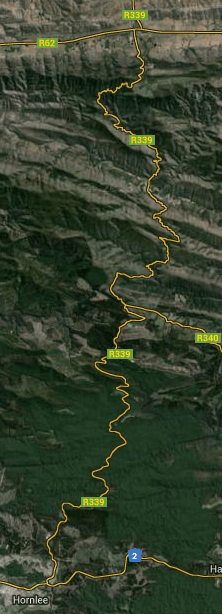
This time around I decided to try the Prince Alfred’s Pass between Knysna and the small town of Avontuur (Afrikaans for “adventure”. I don’t know why they chose that name. It’s one of those places you’ll miss if you were to sneeze while driving through and I spotted nothing particularly adventurous.)
This pass, named for the second son of Queen Victoria, was built in the 1960s by Thomas Bain who was responsible for many of the beautiful passes through South Africa’s mountains. A quick online search told me that, even though untarred for its entire length, the pass is driveable with a regular vehicle and our route was decided.
On Monday we woke up to grey skies and water falling from the skies. After checking that it wasn’t the end of the world arriving six months late, we headed in to Mossel Bay for a bit of museuming and a spot of shopping at the covered flea market. We had last been to the Dias Museum exactly four years ago (give or take a couple of days) on our honeymoon. Here are some photos.
Bartolomeu Dias in the…flesh?The plaque on the statue. It’s in Portuguese.
I’ve mentioned Bartolomeu Dias in a previous post. In 1488 he was the first European (as far as we know) to travel beyond the southern tip of Africa. After landing at Mossel Bay he made it as far as a third of the way between what is today known as Port Elizabeth and East London before his crew forced him to turn back due to fears that their supplies will run out. Consequently Dias never found a route to India as had been the intention, that honour going to his countryman, Vasco da Gama. Continue reading “On vacation (still) Part I”→
On Monday the Reader delivered this post by 23thorns about a high ranking police officer who brought in a sangoma* to investigate a break-in at his office. Just in case you think 23thorns is making this up, here’s the link to the actual news report.
But that’s not what I want to talk about. Someone asked in the comments whether something like this will hold up in court. I jokingly replied whether he really wanted to know and got the following reply:
“I think someone else mentioned it, but this is a dangerous stand…. I hope you are flying under the radar.”
There was another comment on the post asking whether it was “safe to wax political in SA”.
I don’t know what upset me most about these comments – whether it was the fact that this is the view these people have of South Africa, or whether they are cautioning us to be careful about what we say. Continue reading “On speaking out”→
Today is Youth Day in South Africa. It’s the day we remember the Soweto uprisings of 16 June 1976.
I’m not going to bore you with all the history, but in short on that day black high school students took to the streets to protest against a government policy which would have forced them to do receive half their schooling in Afrikaans and half in English with them having no choice in the matter. There were several protest marches in the country with the biggest being in Soweto, Johannesburg where between ten and twenty thousand learners took part.
The protest was initially peaceful. Accounts differ on who started hostilities, but at some point the police fired teargas to disperse the crowd while some of the students started throwing stones at the police who were blocking their intended route. Then the police started firing into the crowd, injuring hundreds. There’s also a lack of agreement on the death toll, with official numbers at the time stating 23, wikipedia saying 176 and a government website claiming as many as 700.
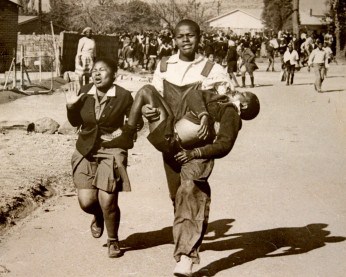
The iconic image by Sam Nzima showing Hector Pieterson, one of the first children to die that day, being carried to safety by Mbuyisa Makhubo, Hector’s sister, Antoinette Sithole, running beside them.
What is agreed is that unarmed children were shot down by police during a peaceful protest. News of the massacre sent shockwaves through the international community and it is commonly hailed as the turning point of the freedom struggle in South Africa.
In 1994, when the ANC came into power, 16 June was declared a national holiday, named Youth Day, to commemorate the lives of the children who died that day and also to honour all youth who had a part in the freedom struggle.
These days that isn’t happening. Nowadays Youth Day seems nothing more than an excuse for a party. Youth Day celebrations are held across the country every year at a cost of millions of rands. Celebrities are flown in, international artists perform, and a bunch of politicians and businessmen sit in the front rows where all the cameras can see them. Some minister or other high-up will give a moving speech about the sacrifices of the youth in the struggle, possibly mentioning Hector Pieterson and Nelson Mandela for good measure, but the rest of the event will be one extravagant bash.
And that, I think, is nothing but an insult to the memory of the kids that died that day. 23, or 176, or 700 kids dying is nothing to celebrate. Not even in the context of South Africa being free today is their deaths a reason for a party.
So, no. I will not be celebrating Youth Day and I won’t be attending any Youth Day celebrations. And it’s not because I’m anti-ANC, or don’t accept my country’s history, or white. It’s because I believe we can better honour the memories of those children by remembering their sacrifice, by saying a prayer for their still-grieving families, and by teaching today’s children about the price that had to be paid so that they can today be free.


 if all else fails...use a hammer