Author: KokkieH

On why I don’t celebrate Youth Day

Today is Youth Day in South Africa.  It’s the day we remember the Soweto uprisings of 16 June 1976.

I’m not going to bore you with all the history, but in short on that day black high school students took to the streets to protest against a government policy which would have forced them to do receive half their schooling in Afrikaans and half in English with them having no choice in the matter.  There were several protest marches in the country with the biggest being in Soweto, Johannesburg where between ten and twenty thousand learners took part.

The protest was initially peaceful.  Accounts differ on who started hostilities, but at some point the police fired teargas to disperse the crowd while some of the students started throwing stones at the police who were blocking their intended route.  Then the police started firing into the crowd, injuring hundreds.  There’s also a lack of agreement on the death toll, with official numbers at the time stating 23, wikipedia saying 176 and a government website claiming as many as 700.
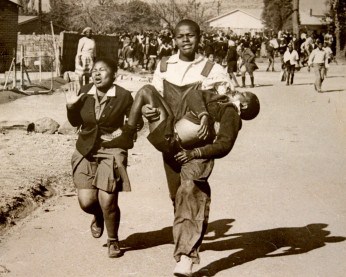
Hector Pieterson 16 June 1976
The iconic image by Sam Nzima showing Hector Pieterson, one of the first children to die that day, being carried to safety by Mbuyisa Makhubo, Hector’s sister, Antoinette Sithole, running beside them.

What is agreed is that unarmed children were shot down by police during a peaceful protest.  News of the massacre sent shockwaves through the international community and it is commonly hailed as the turning point of the freedom struggle in South Africa.

In 1994, when the ANC came into power, 16 June was declared a national holiday, named Youth Day, to commemorate the lives of the children who died that day and also to honour all youth who had a part in the freedom struggle.

These days that isn’t happening.  Nowadays Youth Day seems nothing more than an excuse for a party.  Youth Day celebrations are held across the country every year at a cost of millions of rands.  Celebrities are flown in, international artists perform, and a bunch of politicians and businessmen sit in the front rows where all the cameras can see them.  Some minister or other high-up will give a moving speech about the sacrifices of the youth in the struggle, possibly mentioning Hector Pieterson and Nelson Mandela for good measure, but the rest of the event will be one extravagant bash.

And that, I think, is nothing but an insult to the memory of the kids that died that day.  23, or 176, or 700 kids dying is nothing to celebrate.  Not even in the context of South Africa being free today is their deaths a reason for a party.

So, no.  I will not be celebrating Youth Day and I won’t be attending any Youth Day celebrations.  And it’s not because I’m anti-ANC, or don’t accept my country’s history, or white.  It’s because I believe we can better honour the memories of those children by remembering their sacrifice, by saying a prayer for their still-grieving families, and by teaching today’s children about the price that had to be paid so that they can today be free.

The Crucible (NOT the play about the Salem witch trials)

Here’s another piece I did in my creative writing course last year.  We had to write a conversation where one character was explaining something to another character without it turning into a boring monologue.  I decided to show off and combine it with what we learned about plots the previous week.

The Crucible

“Right, so, every story at some point needs a crucible.”

“Hang on.  What’s a crucible?  I thought this was a writing class, not religion.”

“Crucible, not crucifix.  Technically, it’s a clay container in which you mix chemicals and then heat them up so they’ll react with each other –“

“Now you’re talking about chemistry.  Do you really know about writing?”

“Keep your pants on!  In writing, a crucible is a situation in which two characters are in conflict –“

“So, not a clay pot?”

“…No.”

“Okay.”

“May I continue now?”

“Sure.”

“As I was saying, two characters are in conflict, but it’s a situation they can’t escape, like, being stuck in an elevator, say.”

“Oh!  Just like the chemicals in the clay pot.  I see.  It’s one of them metaphor-thingies.”

“Yes.  One of them metaphor-thingies.  Anyway, then you add something to make the situation worse.”

“Like the building being on fire?”

“Exactly.  So, they have to get out of the stuck elevator before the building burns down with them in it, but they have to sort out their crap first, otherwise they can’t work together to get out, see?”

“Erm.”

“Yes?”

“Why’s the building on fire?”

“Why’s the..?  Forget it!  I give up!”

“Hey, wait!  Where are you going?  Come back!”

Copyright © 2013 Herman Kok

A-weekending we go

It’s long weekend over here (Monday is a public holiday, not that I know what you’re supposed to do with a  long weekend smack bang in the middle of winter) and we’re off to see the in-laws.  Mine and the wife’s.  They live in the same town.  Yet we met each other 1500km away on the other side of the country three years after my dad moved there.  That’s a tale for another day.

Actually we’re driving up for my niece’s christening – yet another thing we can congratulate my step-sister and her husband for (and probably the grandparents as well and I just bet you someone’s going to congratulate me as the proud uncle) that they didn’t actually do.

On the way we’ll be passing through a place with a cinema, so movie-time today, and tonight we’re taking a friend in Jo-burg out for a show for her birthday, so fun-times all around.

I’m not taking the computer along, but through the wonderful ingenuity of the WordPress.com platform and some planning on my part this blog can pretty much carry on without me, but I won’t be able to answer any comments for the next few days, so please don’t feel offended if I don’t.  I’ll get to them.

Have a great weekend (or if you had other plans, whatever).

On stuff people say

The wife’s been feeling poorly since last week, with an initial infection leading to full-blown bronchitis and the doc almost sending her to hospital on Monday out of fear that it will develop into pneumonia.  But, as he told her, the hospital’s full of sick people (I couldn’t believe this tidbit) and she might end up worse than if she just stays at home (that’s what you call irony). Continue reading “On stuff people say”

Make it a good one

This week it is my turn to post on The Book Notes Project.  I have also posted it here for your convenience (and I’m too lazy for two posts in one day).

“We’re all stories, in the end.”

The Doctor says this to a sleeping young Amelia Pond in the Doctor Who episode, The Big Bang.  He is on the wrong side of a crack in time that’s rapidly closing and his story is about to end.  He’s sharing it with one last person in the hope that he would be remembered.

I don’t know whether Steven Moffat intended it this way when he wrote it, but this line gives us a way to look at our lives – as stories. Continue reading “Make it a good one”