I must say, my NaNoWriMo has gotten off to a very slow start. As previously mentioned, last week I attended a workshop on Traumatic Incident Reduction (TIR for short, but more on that later), followed by a weekend at my dad’s, so in the first couple of days I only managed to squeeze out just shy of 400 words. Sunday and Monday were filled with family drama and I only got round to really writing yesterday. Even then it was slow going and I didn’t even meet my quota for one day.
When I updated my word count before bed last night the site informed me that at my current rate I’ll finish my 50k by 20 March next year. So far today I’ve managed to whittle that down to 4 March. I need to speed things up.
Today is the official start of National Novel Writing Month. My trauma counselling course ended yesterday and the wife and I are spending the weekend at our in-laws (both her parents and my dad and stepmom live in the same town, yet we met 1500km away and only after my folks had already been living there for three years), so I probably won’t get much writing done. But today I’m sitting next to the pool with the laptop and am planning to make a decent go of it before the wife joins me here this afternoon.
In the meantime, may your NaNoWriMo not be characterised by moments such as this…
If you’ve been reading this blog for a while you’ll know that I started on a novel early this year. Unfortunately I got stuck roundabout April, seven thousand words in. By June I had decided to put that novel on ice and start over. No writing has happened since apart from what you can see on this blog. That is about to change. Continue reading “If at first you don’t succeed…”→
You know how writing contests (and blog fiction challenges for that matter) always have word limits? Well, Scott Bartlett did not like the six-hundred-word limit of a contest he entered, so he wrote a story making fun of the word limit…and won!
Actually the story can work as a pretty good template for what should be in a short story if you really think about it.
Click on the title to read Six-Hundred by Scott Bartlett.
Stories can’t exist without characters, right? Well, at least most of them need characters. Our first stories feature characters that include dogs, caterpillars, cars, power tools with faces, and purple dinosaurs, to name a few. As we grow our stories become more complex and we get introduced to bad guys, usually trolls or wicked witches. At some point, if you’re paying attention in high school lit, you will further learn that the main character (usually the good guy) is called the protagonist, and his nemesis (usually the bad guy) is called the antagonist.
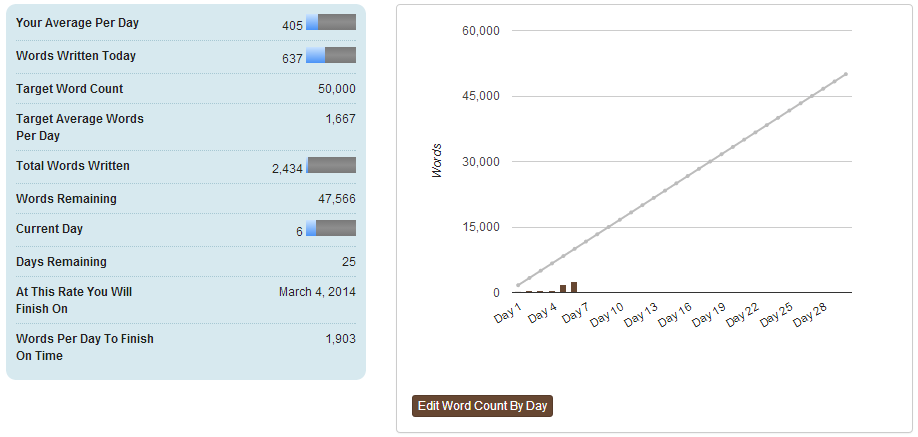 When I updated my word count before bed last night the site informed me that at my current rate I’ll finish my 50k by 20 March next year. So far today I’ve managed to whittle that down to 4 March. I need to speed things up.
 if all else fails...use a hammer